BACK TO PORTFOLIO
B2C SAAS ANDROID FOUNDER LIVE PRODUCT

Subtopia —
Onboarding

A creation-first app where value only exists after users make something. The empty state was the highest dropout point. Redesigned onboarding around the insight that experiencing the product beats being taught about it.

PLATFORM Android · Play Store
ROLE Founder · Product Designer
OUTCOME 96% track creation rate
TOOLS Figma · PostHog

What is Subtopia?

Subtopia is an audio creation and listening platform built for people interested in self-improvement and meditation. It allows users to create personalised audio tracks, tailor their listening experience, and build a consistent daily practice around it.

The idea came from a recurring frustration within these communities. Creating a single track often meant stitching together multiple tools. Writing affirmations in documents, generating voiceovers through online text-to-speech services, recording audio separately, mixing everything in professional audio software and finally listening through music players that were never designed for layered playback.

Despite the popularity of the practice, there was no dedicated product built around the entire workflow.

This fragmentation shaped one of Subtopia's core principles which is user control. Unlike meditation apps that provide a library of pre-made content, Subtopia is built around the belief that self-improvement is deeply personal. A confidence track means something different to a student preparing for interviews than it does to an entrepreneur growing a business. Rather than prescribing content, the product gives users the tools to create experiences that reflect their own goals.

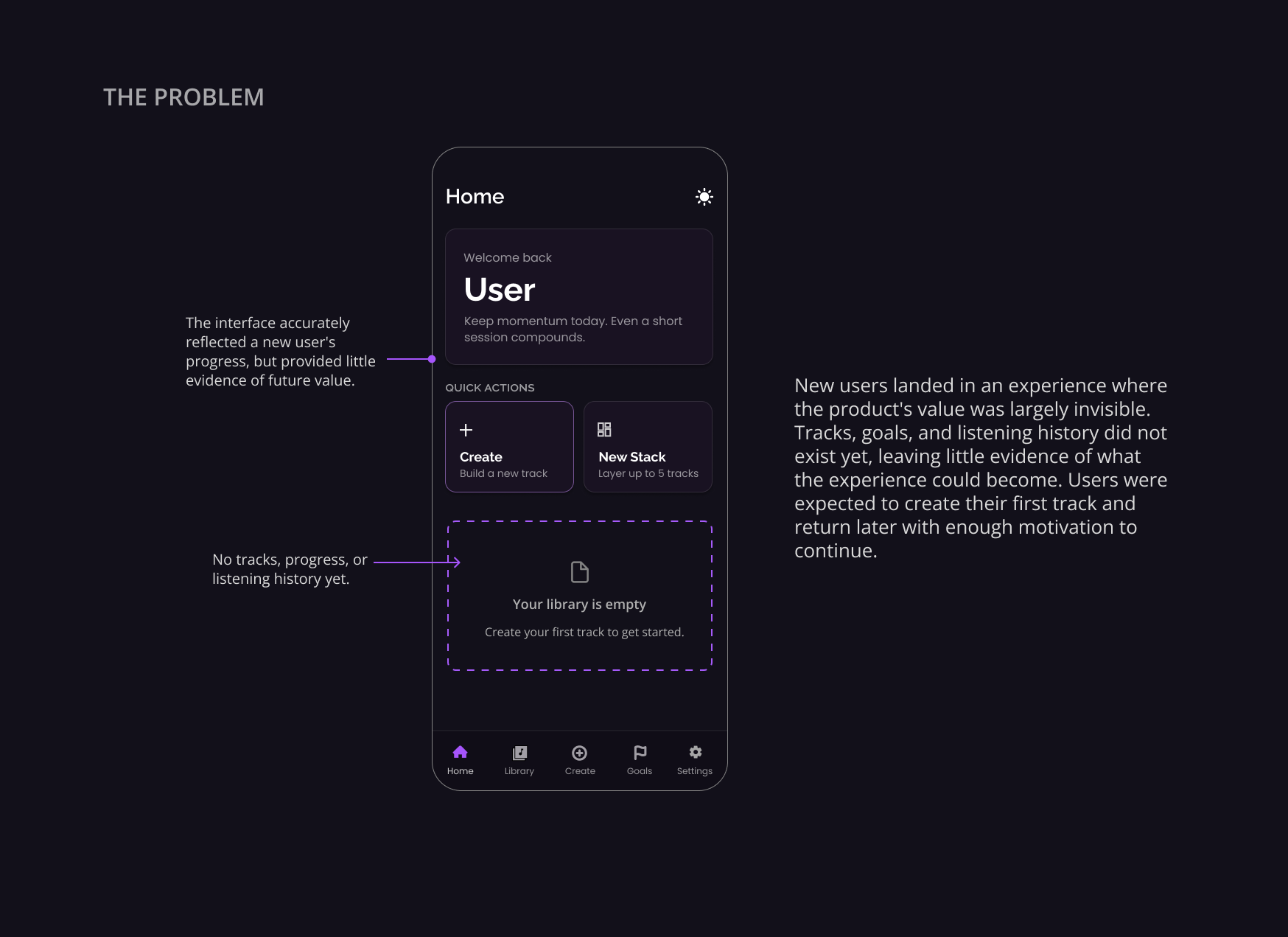
Every screen was empty.

By the time Subtopia was ready to launch, the core product was already there. Users could create tracks, set goals, build listening routines, and manage everything from a single place.

The problem appeared when I looked at the experience through the eyes of someone opening the app for the first time.

Subtopia before screens: Home, Library, and Goals showing empty states

The home screen had no activity. The library had no tracks. Goals had not been created yet. The product only came to life after the user had already invested effort into it.

This was technically correct, but it felt at odds with why people downloaded the app in the first place. Subtopia wasn't designed as a passive listening app. The value comes from creating something personal and building a practice around it. Yet the first experience asked users to imagine that future value before experiencing any of it.

The existing solution, asking users to create their first track from an empty state, still depended on a future commitment. It assumed users would come back later with enough motivation to get started.

That — for a product built around active participation — felt like a risky first impression.

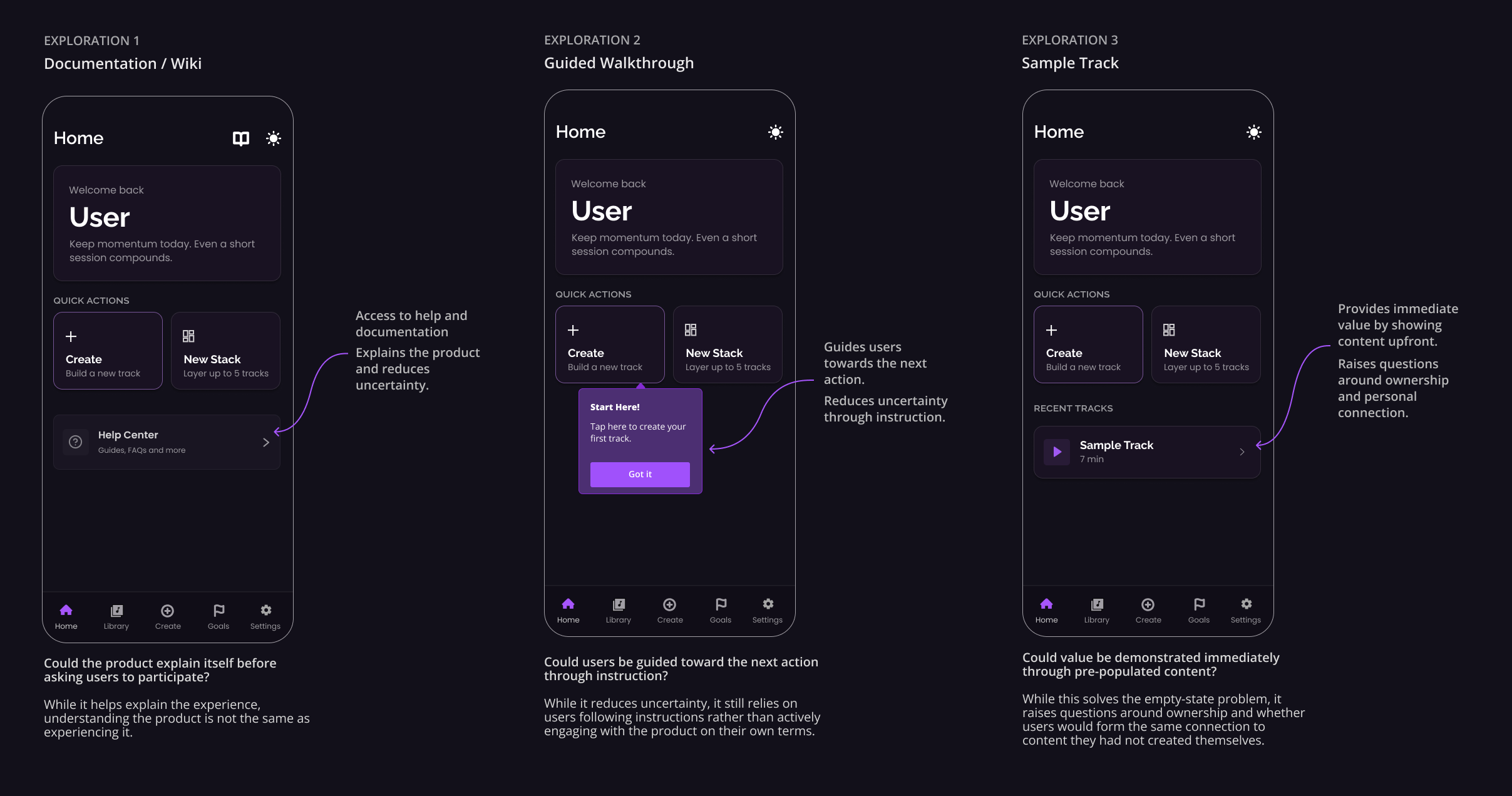
Three directions explored.

The most obvious solution was to keep the existing experience and simply encourage users to create their first track. The problem was that it remained an "act anytime" decision. Users could always postpone it and come back later.

I explored three directions before deciding on a dedicated onboarding flow.

Explorations: Documentation, Guided Walkthrough, and Sample Tracks
1
Documentation / Wiki

One direction was introducing a lightweight guide that explained what Subtopia could do and what users could expect from the experience.

At first, this felt reasonable. Creating personal self-improvement tracks is a meaningful commitment, and some level of uncertainty is natural when someone is deciding whether to trust a platform with that process. A guide could answer questions, showcase possibilities, and make the experience feel more approachable.

The more I explored it, the more it felt like the wrong starting point. Subtopia was built for people who wanted less complexity, not more. The product already required users to actively participate in their own growth. Asking them to read before doing anything added another layer between the user and the experience itself.

The guide helped users understand the product. What it didn't do was help them experience it.
2
Guided Walkthrough

Another direction was a guided walkthrough that introduced the app step by step. Users would be directed through key actions such as creating a track, setting goals, and exploring different parts of the product.

Unlike a guide, this removed the need to read through documentation. It allowed users to learn by doing while reducing the uncertainty of being dropped into a new interface.

The more I mapped the experience out, the more it felt like the product was leading the user rather than the user leading themselves. Progress depended on following instructions, dismissing prompts, and moving through a predefined sequence of steps.

For a product built around personal ownership and active participation, that felt like the wrong dynamic. Users were learning how to use Subtopia, but they still weren't engaging with it on their own terms.

The walkthrough helped users navigate the product. What it didn't do was make the experience feel like theirs.
3
Sample Tracks

The final direction was starting users with a small set of pre-created tracks already available in their library.

This solved the empty-state problem immediately. The app would feel alive from the moment it was opened. Users could explore tracks, listen to them, and get a sense of what was possible before creating anything themselves.

The challenge was that Subtopia was never designed as a content library.

A confidence track can mean entirely different things to different people. Someone may want confidence in social situations, while someone else may want confidence at work. The goal was never to provide content. It was to give users the tools to create something personal to them.

Starting users with predefined tracks changed that relationship. Instead of creating something that reflected their own goals, the first interaction became evaluating content chosen by someone else.

The tracks solved the empty-state problem. What they compromised was ownership.

The outcome of each exploration revealed a different constraint.

The experience could not:

Require learning
Encourage passive participation
Compromise ownership
Rely on future motivation

Creation-first onboarding.

The users Subtopia was built for are not particularly technical, nor do they want a learning curve. The experience needed to feel casual.

By the time users reached the home screen, the learning curve should already be behind them. They would have already created a track, explored the core functionality of the product, and built enough familiarity for the rest of the experience to be discovered naturally.

This led to a creation-first onboarding flow.

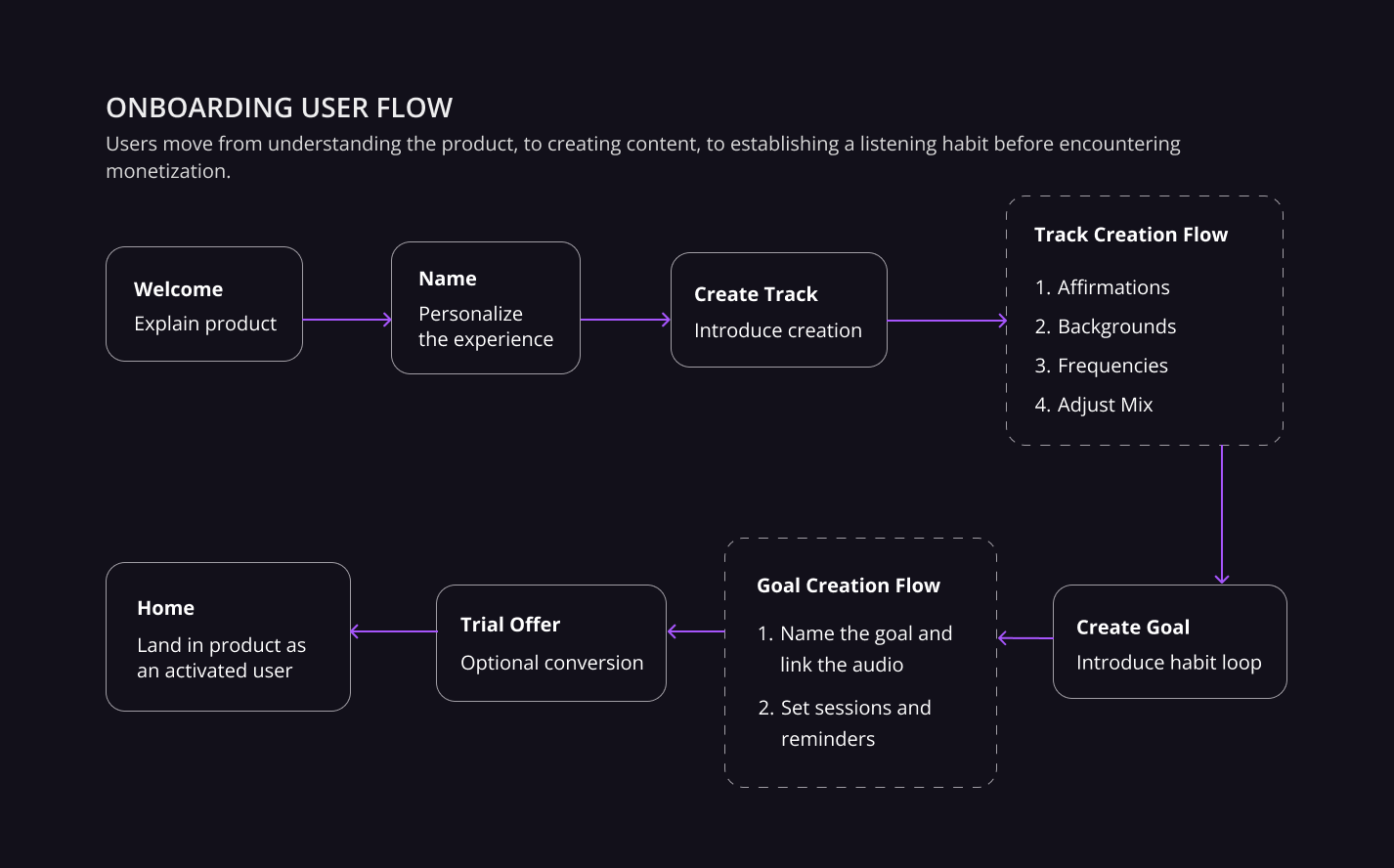
Onboarding wireframes and user flow mapping increasing commitment

Rather than introducing features one by one, the onboarding walks users through a condensed version of the product's core loop: create a track, connect it to a goal, and begin building a listening habit.

The flow was intentionally ordered around increasing commitment.

Entering a name requires little effort while establishing a sense of ownership. Creating a track requires active participation and introduces the product's primary capability. Goal creation comes last because it asks users to think beyond the present moment and commit to a future routine.

The sequence wasn't just about collecting information. Each step prepared users for the next one.

The interface itself relied on familiar interaction patterns. Playback controls, playlists, favourites, and library management follow conventions already established by mainstream consumer apps. Rather than teaching these interactions, the product could rely on existing mental models and focus attention on the behaviours unique to Subtopia.

This also informed what was left out of onboarding. Track creation and goal creation were introduced because they are foundational to the experience. Secondary functionality was left for discovery in context, reducing the amount of information users needed to process upfront.

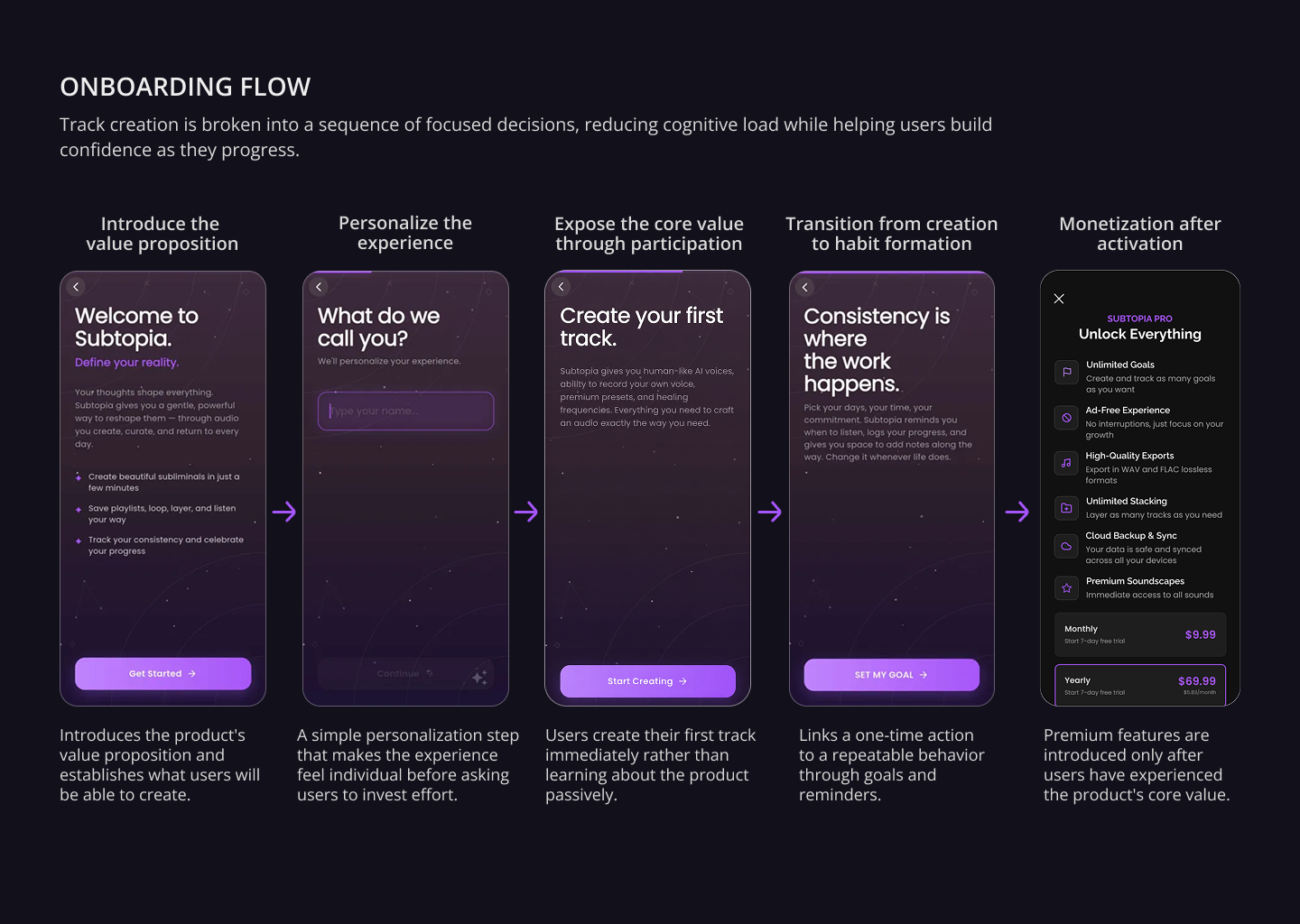
Screen by screen.

Every screen answers one question: "What decision was made here and why?"

STEP 01 Welcome
Why it exists — sets the tone and establishes what Subtopia is before asking the user to do anything.
STEP 02 Name
Why ask for a low-effort commitment first — creates an early sense of ownership with minimal friction.
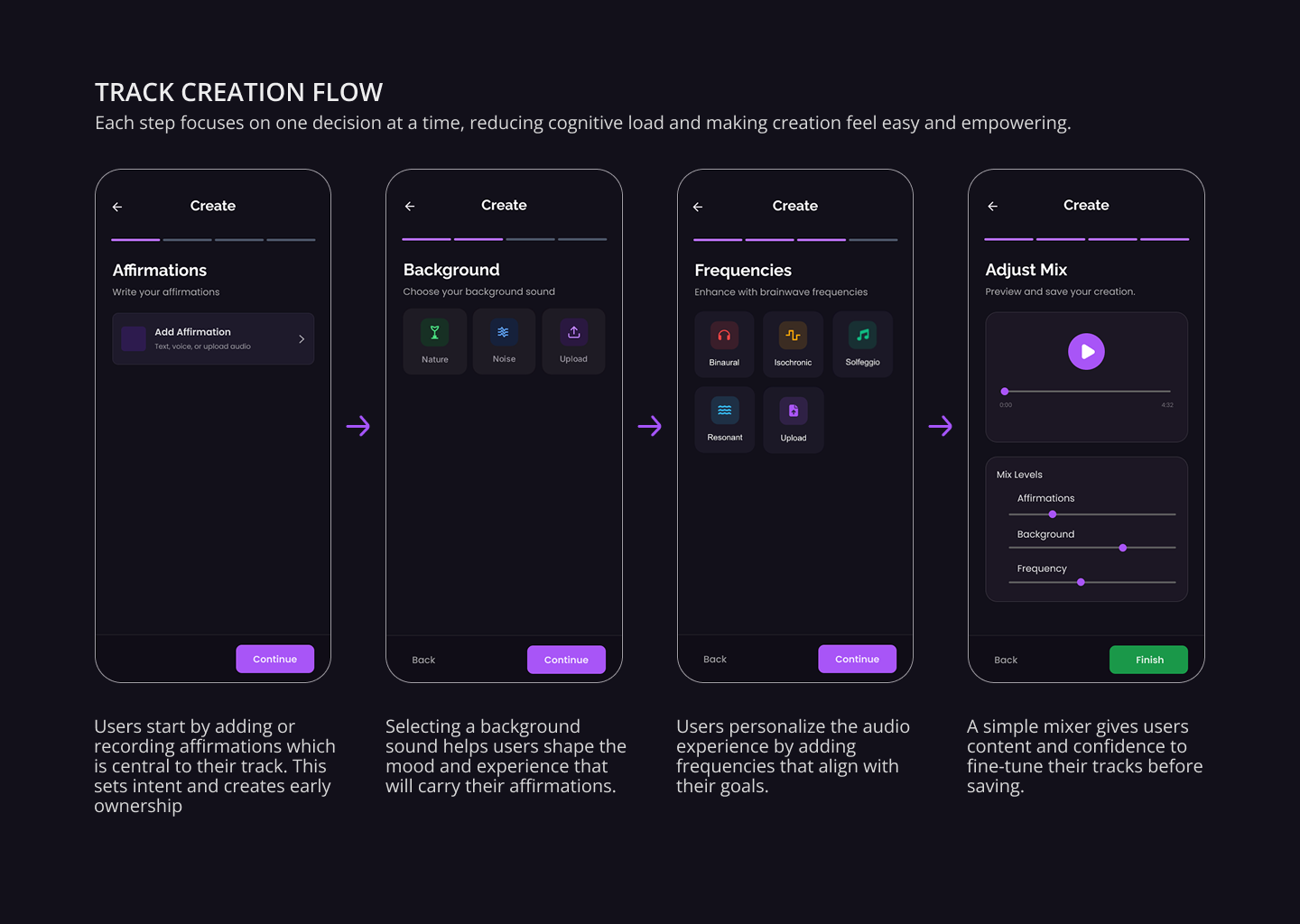
STEP 03 Track Creation
Why this is the first meaningful action — introduces the product's primary capability through active participation.
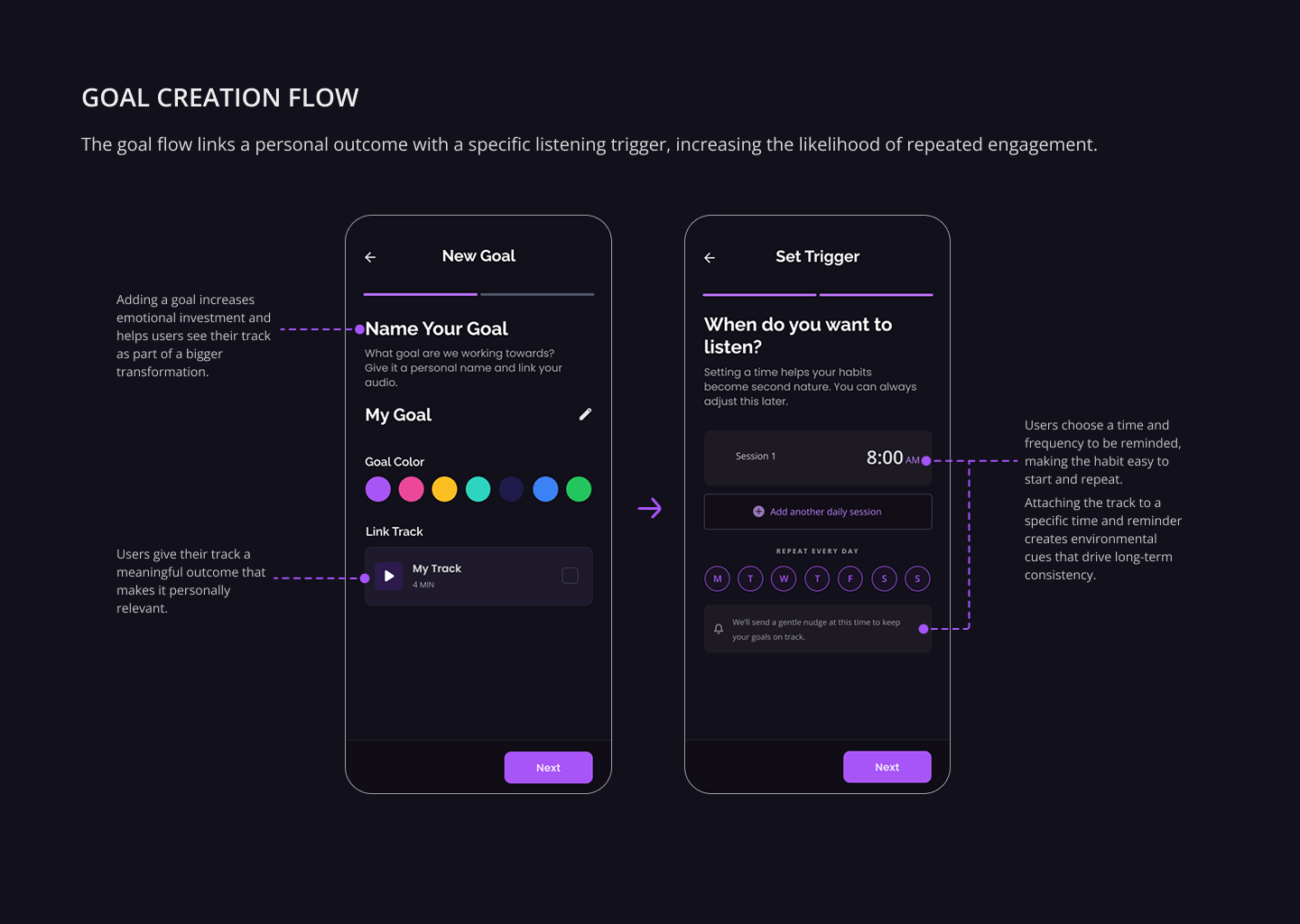
STEP 04 Goal Creation
Why goals were connected to the onboarding experience — connects the track to a personal purpose and future routine.
STEP 05 Consistency Setup
Why habit formation mattered to the product vision — the product's long-term value depends on returning daily.
Onboarding flow: Welcome, Name input
Onboarding flow: Track creation step
Onboarding flow: Goal setup and consistency

Measuring the flow.

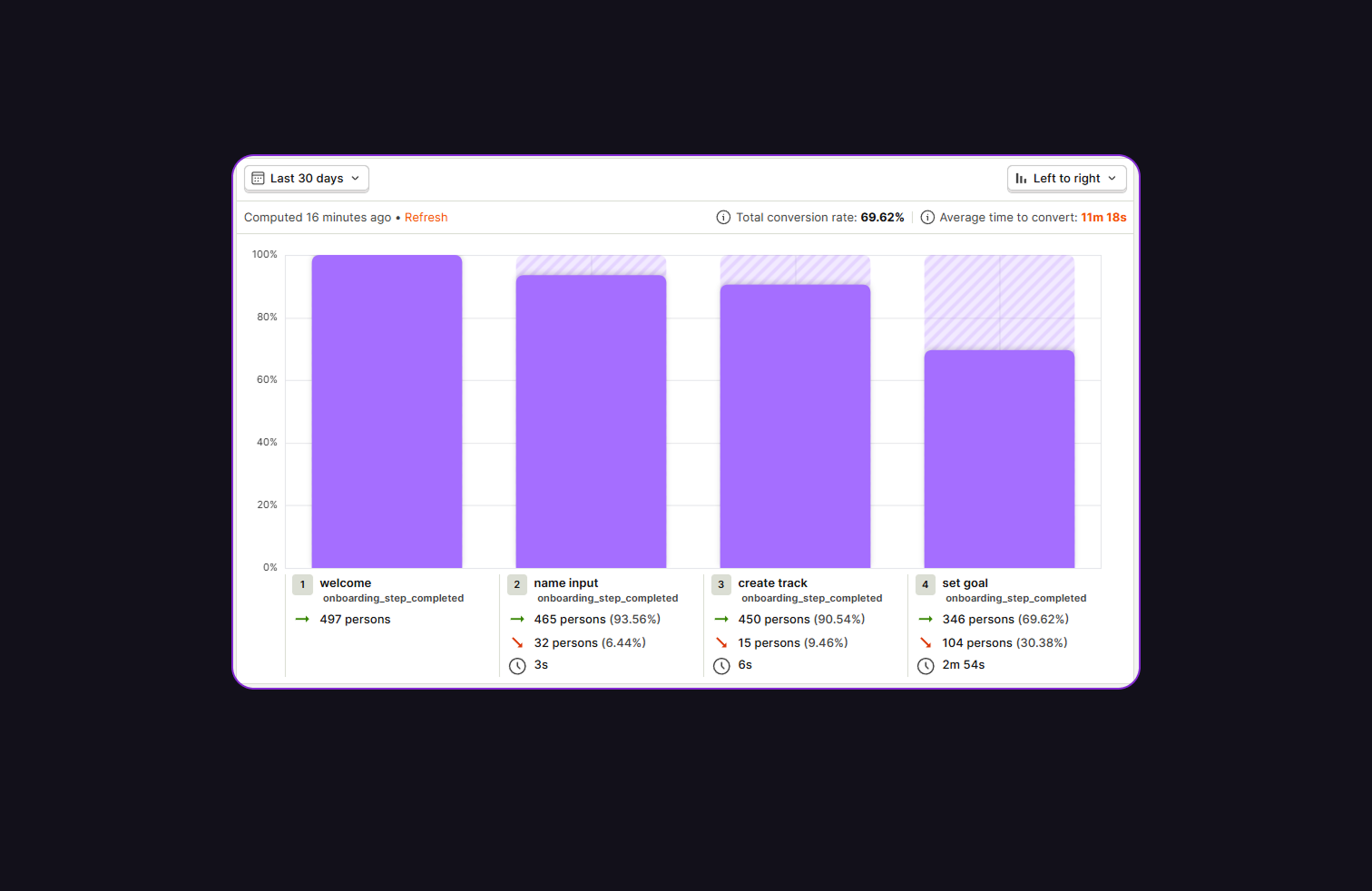
The onboarding launched as part of the first public release and was instrumented using PostHog to understand how users progressed through each step.

WELCOME
100%
NAME
93.5%
TRACK CREATION
90.5%
GOAL SETUP
69.6%
PostHog analytics onboarding completion funnel graph

The data revealed two interesting patterns.

Of the users who reached the creation step, 96% successfully created a track and continued through the flow.

This challenged one of the assumptions behind the redesign. Creating a track is the most involved action in the onboarding experience, yet very few users dropped off at this stage.

The largest drop occurred during goal setup.

While users were willing to create something for themselves, asking them to immediately commit to a future routine appeared to introduce a different kind of friction.

Creation and commitment are different.

The clearest takeaway was that creation and commitment are different behaviours.

Users were willing to create before they were willing to plan. While track creation saw strong completion rates, the largest drop occurred when the flow shifted from creating something in the present to committing to a future routine.

The results also challenged a number of assumptions made during the design process.

I expected track creation to be the highest-friction part of the onboarding. Instead, users completed it at a much rate than anticipated. This suggests the barrier was never the complexity of creation itself, but getting started.

It also reinforced one of the principles that shaped the redesign. Users responded better to experiencing the product than being taught about it. Rather than introducing features through guides, walkthroughs, or examples, the onboarding placed users directly inside the core workflow.

Most importantly, the results validated a core assumption behind Subtopia: people were willing to create their own content. User control, which initially felt like a risk during onboarding, turned out to be one of the product's strengths.

Timing the commitment.

The onboarding successfully introduced users to the product, but the data suggests that goal creation may be appearing too early in the journey.

The next iteration would focus on testing the timing of that commitment rather than redesigning the goal feature itself.

One direction would be making goals optional during onboarding, allowing users to reach the product immediately after creating their first track.

Another would be moving goal creation entirely outside the onboarding flow and introducing it after the first listening session, once users have experienced the value of the product firsthand.

The underlying hypothesis is that creating something and committing to it are different decisions. If users are first allowed to experience the outcome of their effort, they may be more willing to build a routine around it later.

Future iterations would focus on measuring whether delaying that commitment improves onboarding completion without reducing long-term engagement.

NEXT PROJECT

Prime — Execution Layer